Starting a business is exciting.
You have an idea, you've probably already thought about the name, the logo and what the website could look like.
Then comes the uncomfortable question:
Does anyone actually want this?
That's where market research comes in.
Good market research can tell you who your potential customers are, what they want, what they're willing to pay for, who you're competing against and — perhaps most importantly — whether your original idea needs to change.
The good news is that market research doesn't have to mean spending thousands on a research agency or waiting months for a report.
With the tools available in 2026, founders and small businesses can do a surprising amount of meaningful research themselves.
Here's a practical way to approach it.
What is market research?
Market research is the process of collecting and analysing information about a market, its customers and its competitors.
At its simplest, you're trying to answer five questions:
Who are my customers?
What problem do they have?
How are they solving it today?
Who else is trying to solve it?
Would they choose my solution?
These questions apply whether you're launching a SaaS product in Singapore, opening a restaurant in Nairobi, selling consumer products in the UK or launching a local service business in Sri Lanka.
The market might be different.
The fundamentals aren't.
Step 1: Start with the problem, not the product
This is where many new businesses go wrong.
They fall in love with the solution before understanding the problem.
For example, imagine someone wants to launch an app that helps people find healthier meals.
The initial idea might sound good.
But market research should come before development.
You could ask:
- Do people actually struggle to find healthy meals?
- How frequently does the problem occur?
- What do they currently do about it?
- Is price the biggest issue?
- Is convenience the biggest issue?
- Are existing apps solving the problem?
- Would customers actually download another app?
You might discover that people don't need another food discovery app.
Maybe they want affordable meal delivery.
Maybe they care more about calorie information.
Maybe the real problem is that existing healthy food options are too expensive.
That discovery could save months of development.
The purpose of market research isn't to prove your idea is good. It's to find out whether your assumptions are wrong.
Step 2: Define your target market
"Everyone" isn't a target audience.
If your answer to "Who is your customer?" is everyone, your research isn't specific enough yet.
A target audience could be:
- University students in Singapore
- Small business owners in Nairobi
- Parents with children under 12
- Marketing managers at technology companies
- Freelancers in the UK
- Fitness-conscious consumers aged 20–35
- Restaurants looking for customer analytics
The more clearly you define your audience, the more useful your research becomes.
You can start by defining:
Demographics
Age, location, income, occupation and other relevant characteristics.
Behaviour
What they currently buy, use, search for or do.
Needs
What problems they experience.
Preferences
What they value when choosing between alternatives.
Buying behaviour
What makes them purchase — or decide not to.
You don't necessarily need dozens of variables.
You need the variables that actually matter to the decision you're trying to make.
Step 3: Research your competitors
Competitor research isn't simply making a list of companies that do something similar.
You want to understand why customers choose them.
Create a simple comparison covering:
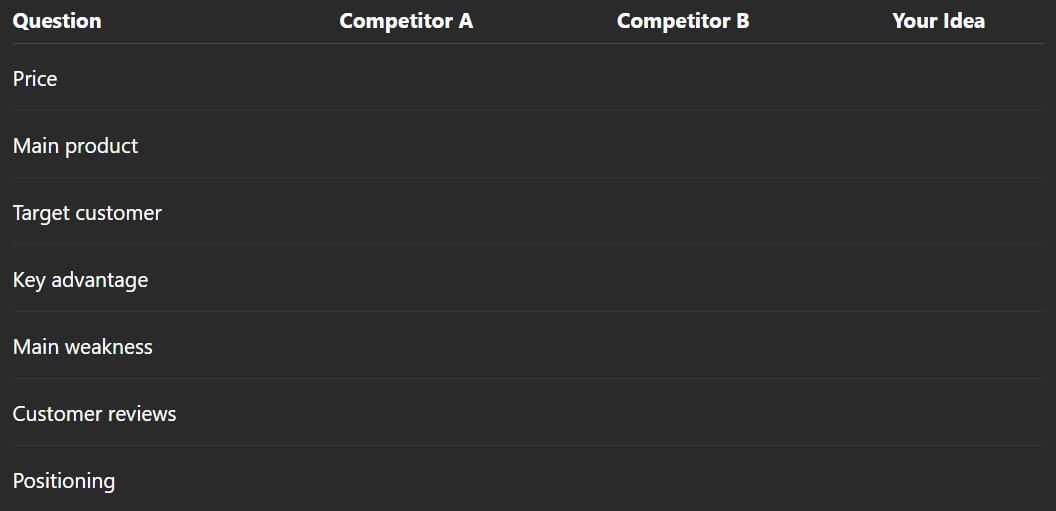
Then go further.
Read customer reviews.
Look at Reddit discussions.
Check social media comments.
Read complaints.
Look for phrases such as:
"I wish they would..."
"The problem with this is..."
"I switched because..."
Those complaints can be more valuable than a competitor's homepage.
Why?
Because competitors tell you what they want customers to think.
Customers tell you what they actually experience.
Step 4: Talk to potential customers
This remains one of the most important parts of market research.
If you can speak directly to potential customers, do it.
Don't immediately pitch your product.
Instead, ask about their existing behaviour.
For example, instead of:
"Would you use an app that does X?"
Ask:
"How do you currently solve X?"
Then:
"What's frustrating about that process?"
And:
"How often does that happen?"
This distinction is important.
People are often very good at saying they would use something.
They're less reliable when predicting what they will actually do.
Existing behaviour is therefore extremely valuable.
Step 5: Use surveys to test your assumptions
Once you have some initial understanding of your audience, surveys can help you collect structured responses from a larger group.
A good market research survey might explore:
Problem awareness
"How frequently do you experience this problem?"
Current behaviour
"What do you currently use to solve it?"
Preferences
"Which feature would be most valuable to you?"
Price sensitivity
"Which price would you consider reasonable?"
Purchase intent
"How likely would you be to try this product?"
Barriers
"What would stop you from using it?"
The key is not to ask 40 questions just because your survey tool allows it.
Every question should help you make a decision.
Step 6: Segment your market
One of the biggest advantages of collecting research data is discovering that your customers aren't necessarily one group.
Suppose you survey 500 people about a new productivity application.
Overall, 55% might say they're interested.
That sounds encouraging.
But once you segment the results, you might discover:
18–24: 72% interested 25–34: 61% interested 35–44: 43% interested 45+: 29% interested
Suddenly, your market looks different.
You may have discovered that your strongest opportunity isn't "everyone who wants to be productive."
It's a particular customer segment.
This is why good market research looks beyond the overall percentage.
The average customer doesn't always exist.
Step 7: Don't ignore qualitative research
Numbers tell you what is happening.
Qualitative research can help explain why.
Imagine 68% of your respondents say price is their biggest concern.
That's useful.
But you still don't know exactly what "price" means to them.
Is the product genuinely too expensive?
Are competitors cheaper?
Do they not understand the value?
Would they pay more for additional features?
This is where interviews and focus groups become valuable.
And this is also one of the areas where AI-powered research is becoming increasingly interesting.
Instead of only analysing survey percentages, businesses can use AI-generated research participants to explore different viewpoints, test questions and identify themes worth investigating further.
Step 8: Use AI carefully
AI has changed how quickly businesses can conduct market research.
Today, AI can help with:
- Survey design
- Competitor analysis
- Customer segmentation
- Data analysis
- Research summaries
- Persona creation
- Hypothesis generation
- Synthetic respondents
- Qualitative analysis
- Follow-up question generation
But there's an important distinction.
AI can accelerate research. It doesn't automatically make research accurate.
If you ask an AI model to invent what customers think, you're still making an assumption.
That's why AI-generated research should be treated as a way to explore possibilities and generate hypotheses — particularly in the early stages.
For important decisions, those hypotheses should ideally be tested against real customers.
Step 9: Consider synthetic market research
This is where synthetic market research can be useful.
Synthetic respondents are AI-generated participants designed to simulate members of a particular target audience.
For example, instead of asking an AI:
"What would customers think about my product?"
you can create a defined audience and ask multiple simulated respondents the same research questions.
The objective isn't to pretend that these respondents are real people.
It's to create a fast environment where you can explore different assumptions before committing significant time or money to primary research.
For a startup, that can be particularly useful.
You might test:
- Two different product concepts
- Several pricing options
- Different advertising messages
- Customer objections
- Feature preferences
- Different target segments
- Survey questions before sending them to real participants
The output isn't the final answer.
It's a starting point.
Step 10: Turn your research into a decision
This is the part people often forget.
Market research isn't useful simply because you have collected data.
You need to do something with it.
At the end of your research, you should be able to answer questions such as:
Should we launch?
Should we change the product?
Who should we target first?
What should we charge?
Which feature should we prioritise?
Which customer segment looks most promising?
What assumption should we test next?
If your research doesn't change or validate a decision, ask yourself why you collected it in the first place.
A simple market research framework for startups
If you're a founder without a research team, you don't need to make this unnecessarily complicated.
Start with this framework:
1. Identify the problem
What problem are you trying to solve?
2. Define the audience
Who experiences the problem most strongly?
3. Research competitors
How are people solving it today?
4. Speak to customers
Understand their existing behaviour and frustrations.
5. Run a survey
Test your assumptions with structured questions.
6. Segment the results
Look for differences between customer groups.
7. Test your biggest assumptions
Use interviews, focus groups or additional research.
8. Make a decision
Change, continue, pause or abandon the idea.
That's market research.
It doesn't need to be a 70-page presentation.
How much does market research cost?
There isn't one answer.
Traditional market research can range from relatively inexpensive surveys to large-scale studies costing thousands of dollars.
For a small business or startup, the important thing is to match the research method to the decision.
You don't need to spend $10,000 finding out whether people understand your product idea.
Equally, you probably shouldn't make a multimillion-dollar business decision based entirely on a quick AI-generated survey.
The best approach is often to start cheaply, learn quickly and increase research depth as the decision becomes more important.
The future of market research
Market research is becoming more accessible.
A founder doesn't necessarily need a large research department to start asking meaningful questions about a market.
Search data, customer reviews, surveys, interviews, analytics and AI-powered research tools can all contribute to the picture.
The interesting part isn't that one of these methods will replace everything else.
It's how they can work together.
You might use AI to generate initial hypotheses.
Use competitor research to identify gaps.
Use synthetic respondents to explore possible reactions.
Use a real survey to validate the strongest findings.
Then speak directly to customers to understand the reasoning behind the numbers.
That creates a much stronger research process than relying on any single source.
Final thought: research before you build
The most expensive market research mistake isn't spending too much money.
It's building something nobody really wants.
A week of research can sometimes save months of development.
A simple customer conversation can challenge an assumption you've had for six months.
A survey can reveal a customer segment you hadn't considered.
And an AI-powered research tool can help you explore dozens of ideas before deciding which ones deserve real-world validation.
That's the direction we're building towards at AskYourMarket.
Not replacing real people.
Not pretending AI has all the answers.
Simply making it easier to ask better questions before making expensive decisions.
If you're building a new business, testing a product idea or trying to understand a market, that's a good place to start.
Research first. Build second.
Frequently Asked Questions
What is market research?
Market research is the process of collecting and analysing information about customers, competitors and a specific market to support business decisions.
How do I do market research for a startup?
Start by identifying the problem, defining your target audience, researching competitors, speaking to potential customers and running surveys. You can also use AI-powered research tools to explore assumptions before conducting larger primary research.
What is AI market research?
AI market research uses artificial intelligence to assist with activities such as survey creation, customer analysis, segmentation, qualitative research and synthetic respondent testing.
What are synthetic respondents?
Synthetic respondents are AI-generated research participants designed to simulate the characteristics, perspectives and potential responses of a particular target audience.
Is AI market research accurate?
It depends on the research method and question. AI-generated research can be useful for early-stage exploration and hypothesis generation, but it should not automatically be treated as equivalent to statistically representative research with real people.
Is market research necessary for a new business?
Market research isn't a guarantee of success, but it can significantly reduce uncertainty by helping businesses understand customers, competitors, demand and potential problems before investing heavily in a new idea.