How to Validate a Business Idea Before Spending Money on Market Research
Having a business idea is easy. Knowing whether people actually want it is much harder.
Before spending thousands on development, advertising, branding, inventory, or a large market research project, founders can test their assumptions first.
The goal isn't to prove that an idea will succeed. It's to find out what you don't know yet.
A useful validation process can help answer questions such as:
- Who is most likely to want this?
- What problem are they actually trying to solve?
- What alternatives are they using today?
- What would make them consider switching?
- How much might they be willing to pay?
- Which parts of the idea need more research?
- What questions should you ask real customers?
For early-stage ideas, this initial research can be done relatively quickly before moving into more expensive forms of validation.
What does it mean to validate a business idea?
Business idea validation is the process of testing whether a proposed product, service, problem, or business model has enough potential to justify further time and investment.
Validation usually involves testing assumptions about the target audience, problem, competition, pricing, demand, and product concept.
Importantly, validation is not the same as proving that a business will succeed.
There is no survey, interview, or AI-generated simulation that can guarantee product-market fit.
Instead, good validation reduces uncertainty before you make a larger commitment.
Why validate an idea before building it?
One of the most expensive mistakes a founder can make is building the solution before understanding the problem.
For example, imagine someone wants to build a $20/month productivity app for university students.
There are several assumptions hidden inside that idea:
- Students have the problem.
- The problem is important enough for them to solve.
- Existing alternatives aren't good enough.
- Students would consider another product.
- The proposed features address the problem.
- Some students would pay $20/month.
- The intended audience is actually the right audience.
Building the product first means spending time and money before testing most of those assumptions.
A better approach is to identify the assumptions that matter most and test them first.
Step 1: Define exactly who you are building for
"Everyone" is rarely a useful target market.
Instead, create a specific audience description.
For example:
University students aged 18–24 in the UK who work part-time, struggle with managing assignments and shifts, and already use at least one productivity app.
This gives you something concrete to investigate.
Depending on the idea, you might define an audience using:
- Age
- Location
- Income
- Occupation
- Education
- Household situation
- Category familiarity
- Buying behavior
- Price sensitivity
- Existing products used
The more clearly you define the audience, the more useful your research questions become.
Step 2: Separate assumptions from facts
Write down what you currently believe about the market.
For example:
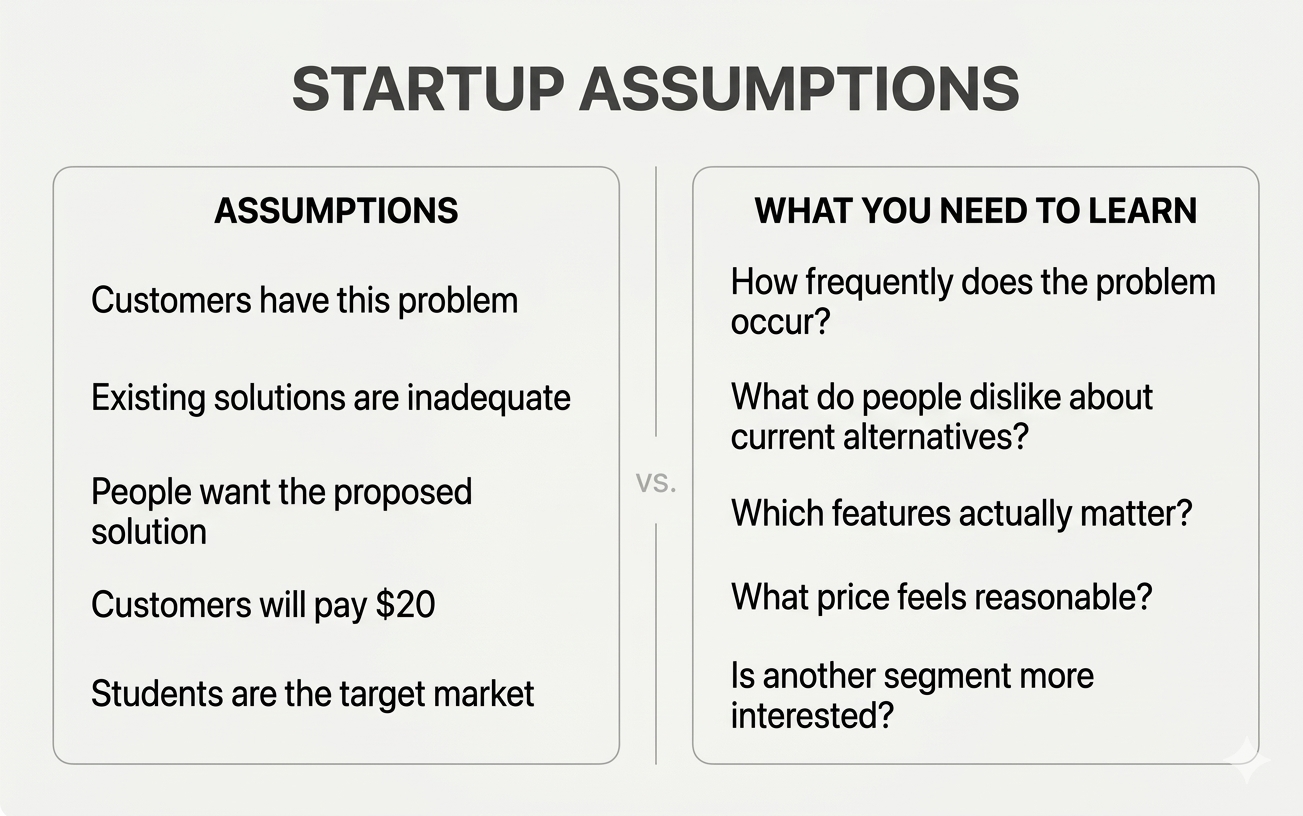
This turns a vague business idea into a list of research questions.
That distinction matters because early market research should not simply ask, "Do you like my idea?"
It should investigate the assumptions underneath the idea.
Step 3: Research the existing market
Before asking people about your product, understand what already exists.
Look at:
- Competitors
- Alternative solutions
- Pricing
- Customer reviews
- Product features
- Complaints
- Reddit discussions
- Community forums
- Search behavior
- Industry reports
Customer complaints can be particularly valuable.
If people repeatedly complain about the same limitation in an existing product, that may reveal an opportunity.
On the other hand, if customers already have several effective solutions and show little interest in changing, that is useful information too.
The objective is not to find evidence that confirms your idea.
It is to discover where your assumptions may be wrong.
Step 4: Ask the right questions
A weak survey can produce a lot of data without producing much insight.
Avoid questions such as:
"Would you use an app that solves this problem?"
People can easily say yes to hypothetical products.
Instead, ask questions that reveal existing behavior.
For example:
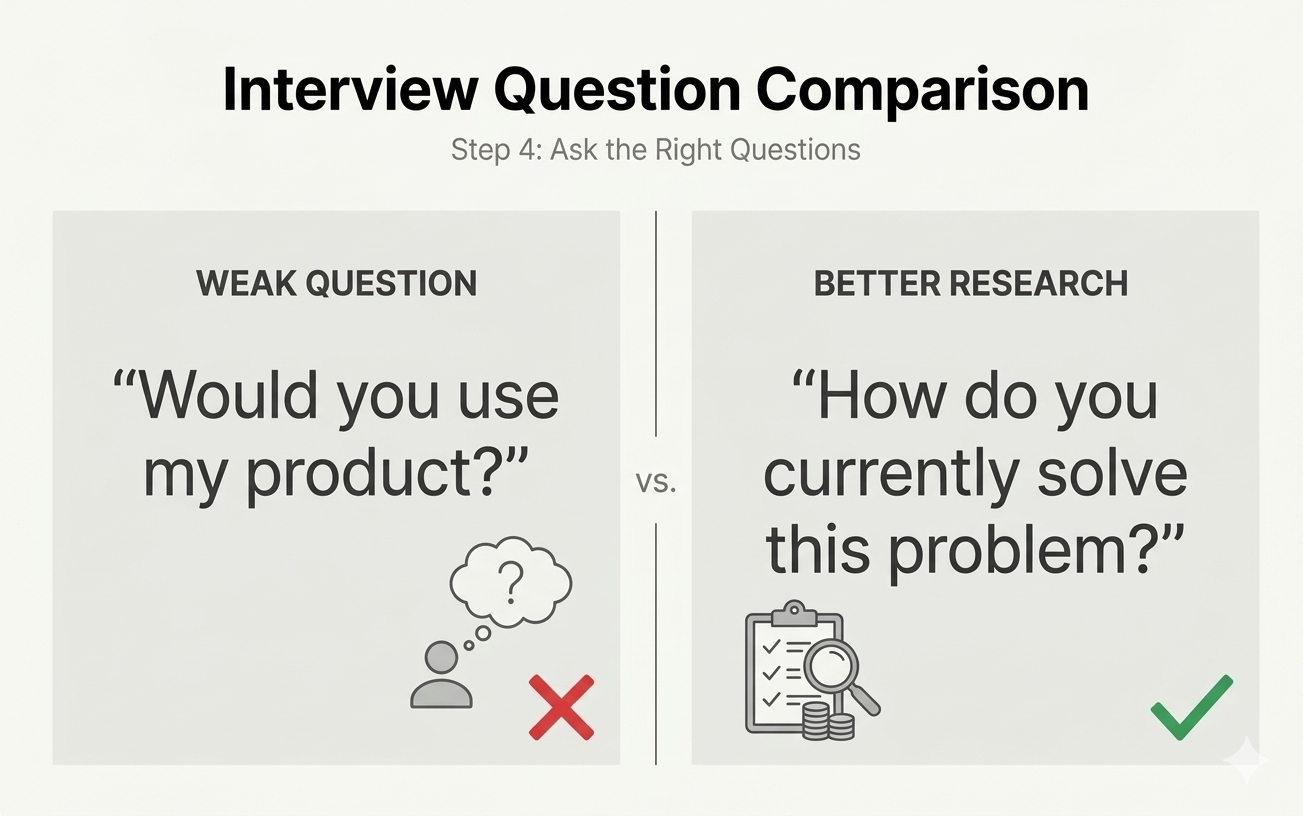
Weak question:
Would you use an app that helps you manage your university schedule?
Stronger questions:
How do you currently manage your university schedule?
What is the most frustrating part of managing it?
What tools do you currently use?
Have you ever paid for a productivity tool?
What made you choose your current solution?
What would make you switch to another solution?
These questions give you information about behavior rather than simply asking for approval.
Step 5: Test different segments
Your first target audience might not be your best target audience.
Suppose you're developing software for small businesses.
You could compare:
- Freelancers
- Agencies
- Small retailers
- SaaS companies
- Professional service firms
Instead of asking only whether people like the concept, compare how different segments respond to the same questions.
You might discover that one group has a much stronger problem than the others.
That can change your positioning before you spend heavily on acquisition.
Step 6: Test pricing separately
Pricing deserves its own research.
A product can have demand and still fail commercially if the economics don't work.
You can investigate:
- Expected price
- Price sensitivity
- Willingness to pay
- Preferred pricing model
- Monthly vs annual plans
- Features users associate with higher prices
However, stated willingness to pay is still hypothetical.
Someone saying they would pay $30 does not necessarily mean they will pull out their credit card.
Use pricing research to develop hypotheses, then validate those hypotheses through actual behavior.
Step 7: Use synthetic market research for the first pass
This is where synthetic market research can be useful.
Instead of immediately recruiting a real survey panel, you can create a simulated population based on your target audience and run your initial questionnaire against it.
AskYourMarket, for example, lets you describe an audience, create synthetic respondents with defined characteristics, run structured questionnaires, and examine results across segments.
The respondents and results are explicitly synthetic, so the output should be treated as directional exploration rather than real-world population estimates.
This distinction is important.
Synthetic market research should not be presented as a replacement for a representative human survey.
Its value is in helping you explore the research problem before spending more time and money.
What can you learn from synthetic market research?
A synthetic study can help you explore questions such as:
- Which assumptions deserve more investigation?
- Which audience segments appear most interesting?
- Which survey questions produce useful differentiation?
- Which features should be investigated further?
- What pricing questions should be tested with real customers?
- What objections might deserve follow-up?
- Which groups should you recruit for primary research?
For example, imagine you are considering a meal-planning product for busy parents.
Rather than immediately paying for a large research panel, you could first define an audience such as:
Parents aged 30–45 in Sydney with two or more children, full-time employment, and medium-to-high price sensitivity.
You could then explore questions around:
- Current meal-planning behavior
- Existing alternatives
- Biggest frustrations
- Desired features
- Purchase intent
- Price sensitivity
The resulting information can help you decide what to investigate with real people.
Synthetic market research vs asking ChatGPT
A general AI assistant can be useful for brainstorming an idea.
You can ask ChatGPT:
"What might busy parents think about a meal-planning app?"
But there is an important difference between generating opinions and simulating a structured research population.
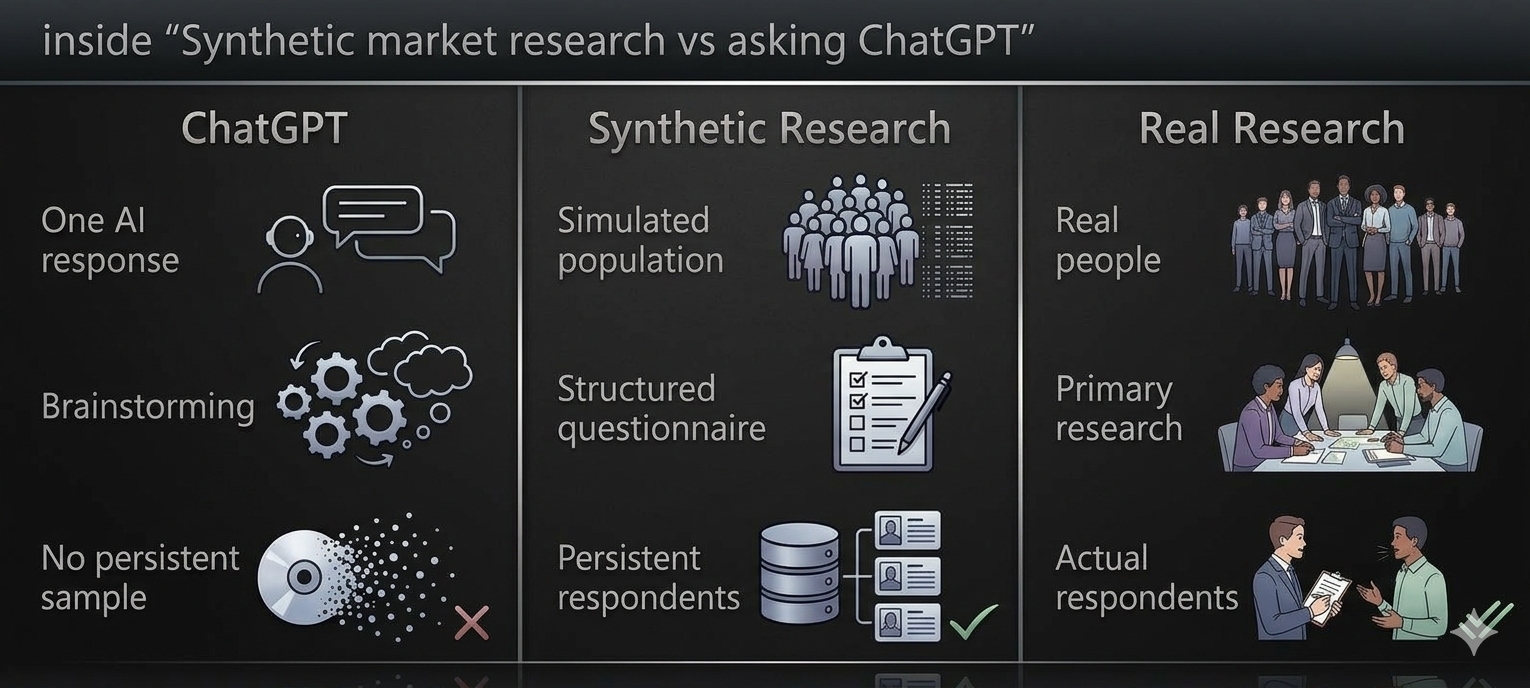
A structured synthetic research workflow can define a population, give respondents persistent profiles, ask the same questionnaire to that population, compare segments, and produce structured results.
That makes it closer to a research instrument than a one-off conversation.
AskYourMarket uses this approach by creating respondent profiles that persist throughout a study, allowing the same simulated population to answer multiple questions and follow-ups.
That still does not make the respondents real people.
The distinction should remain clear:
Chatbot → individual AI-generated response
Synthetic market research → structured simulated population
Primary research → responses from actual people
Each serves a different purpose.
Step 8: Take the strongest questions to real people
Once you have explored your assumptions, don't stop there.
Take the most important unanswered questions into real-world research.
Depending on your situation, this could include:
- Customer interviews
- Real surveys
- Landing-page tests
- Pre-orders
- Prototype tests
- User interviews
- Paid advertising experiments
- Waitlists
- Product trials
- Sales conversations
The goal is to move from hypothesis → evidence → stronger evidence.
Synthetic research can help you decide what to investigate.
Real customers ultimately determine whether the market behaves the way you expect.
A practical business idea validation workflow
For many early-stage founders, a useful sequence looks like this:
1. Define the idea
What are you building and what problem does it solve?
↓
2. Define the audience
Who specifically experiences the problem?
↓
3. List your assumptions
What has to be true for the idea to work?
↓
4. Research the existing market
What alternatives already exist?
↓
5. Run an initial synthetic study
Explore the audience, questions, segments, objections and pricing hypotheses.
↓
6. Improve your questionnaire
Remove weak questions and focus on the assumptions that matter.
↓
7. Talk to real people
Test your most important assumptions with actual customers.
↓
8. Test behavior
Move beyond opinions into actions such as signups, pre-orders, trials or purchases.
↓
9. Decide what to build
Use the evidence to refine, change or abandon the original idea.
This approach doesn't eliminate uncertainty.
It helps you avoid spending heavily while important questions are still unanswered.
How long should idea validation take?
There is no universal timeline.
A simple idea can be explored in a few hours.
A complicated B2B product may require weeks of interviews, competitive research and experiments.
The important question isn't:
"How quickly can I validate my idea?"
It is:
"What is the cheapest and fastest way to answer the next important unknown?"
For an early-stage founder, that might mean spending an afternoon researching competitors and testing a questionnaire before paying for a large research study.
Common mistakes when validating a business idea
1. Asking people whether they "like" the idea
Positive feedback feels good but isn't necessarily evidence of demand.
Focus on behavior, existing problems, alternatives and willingness to take action.
2. Only talking to friends
Friends may be useful for early feedback, but they usually aren't representative of your target market.
3. Asking leading questions
"Would you love an easier way to do X?" encourages a positive response.
Neutral questions usually produce more useful information.
4. Treating survey results as guaranteed demand
A survey measures what respondents say under the conditions of the research.
It doesn't guarantee future purchases.
5. Confusing synthetic respondents with real customers
Synthetic respondents are simulated.
Their responses can help with exploration, but they are not evidence that real customers hold the same opinions.
6. Validating everything except willingness to pay
A product can solve a real problem and still have a business-model problem.
Pricing should be investigated early.
7. Continuing research forever
Research should eventually lead to an action.
The objective isn't to achieve perfect certainty.
It's to gather enough evidence to make the next decision intelligently.
When should you use real market research?
Use real market research when you need evidence about actual people.
This is particularly important when you need:
- Representative population estimates
- Publishable research
- Customer evidence for major investment decisions
- Regulatory or medical claims
- High-confidence market sizing
- Actual purchase behavior
- Evidence that will be presented as human opinion
Synthetic market research is better positioned as an early-stage exploration layer.
For example:
Idea → synthetic research → improved hypotheses → real research → real-world experiment
rather than:
Idea → synthetic research → launch
That distinction prevents early research from being mistaken for proof.
The goal isn't to prove your idea
The most useful result from early market research isn't always:
"People love my idea."
Sometimes the most valuable result is:
"We're asking the wrong audience."
Or:
"The problem is real, but this feature isn't important."
Or:
"The price assumption is probably wrong."
Or:
"We need to speak to a completely different customer segment."
Finding those problems early can save weeks or months of work.
That's what makes validation useful.
FAQ: Business idea validation
What is the best way to validate a business idea?
Start by defining the target audience and the assumptions behind your idea. Research existing alternatives, ask neutral questions about current behavior, investigate pricing, and then validate the most important assumptions with real customers and real-world experiments.
How can I validate a startup idea before building it?
You can start with competitor research, customer interviews, surveys, landing-page tests, prototype testing, and early market research. Synthetic market research can also be used as an exploratory step before recruiting real respondents.
How do you test whether people want a product?
Don't rely only on people saying they like the concept. Look for stronger evidence such as existing behavior, willingness to switch, signups, pre-orders, trials, interviews and purchases.
What questions should I ask when validating a business idea?
Ask about the customer's current behavior, the problem they experience, existing alternatives, frustrations, purchase behavior, desired outcomes, price sensitivity and what would make them switch solutions.
Can AI help validate a business idea?
Yes. AI can help with competitor research, questionnaire design, hypothesis generation, audience analysis and synthetic market research. However, AI-generated responses should not automatically be treated as real customer evidence.
What is synthetic market research?
Synthetic market research uses AI-generated respondents to simulate a defined target population and answer structured research questions. The results are simulated and should generally be treated as directional rather than as a replacement for primary research.
Is synthetic market research a replacement for real market research?
No. Synthetic market research can help with early exploration, questionnaire development, segmentation and hypothesis generation, but real people are still necessary when you need evidence about actual customers or a representative population.
How can I validate a business idea without spending much money?
Start with free or low-cost activities such as competitor research, customer conversations, community research, landing-page experiments and questionnaire testing. Synthetic research can also provide a relatively inexpensive way to explore assumptions before investing in a larger primary research study.
Final takeaway
You don't need to spend thousands of dollars to start investigating a business idea.
You need to understand what you're assuming, who you're assuming it about, and which questions matter most.
Use early research to challenge your assumptions. Use synthetic research when it helps you explore the market and improve your research. Then take the most important questions to real people and test actual behavior.
The purpose of validation isn't to make you feel confident about an idea.
It's to help you make a better decision before you spend too much on it.
Ask your target market before you ask the real one.
AskYourMarket lets you create a synthetic target audience, run structured questionnaires, compare segments, explore purchase intent and follow up with simulated focus groups — while clearly labelling the results as synthetic.